8 Best Payment Reconciliation Software Tools in 2026
Payment reconciliation software matches payments across processors, banks, and the ledger, netting fees, refunds, and chargebacks. Here are the 8 best payment reconciliation software tools in 2026, from Modern Treasury and Stripe to AI agents like Concourse, compared by source coverage, fit, and cost.

Every payment a business takes in has to be reconciled: the money that lands in the bank has to be matched to the processor's payout, the fees netted out, the refunds and chargebacks accounted for, and the whole thing tied back to the orders or invoices and the general ledger. Do it by hand across Stripe, the bank, and the ERP and it is slow and error-prone. Payment reconciliation software automates that matching, so the cash that arrives can be trusted and the books close faster.
Payment reconciliation overlaps with, but is not the same as, two neighbors: cash application matches customer payments to AR invoices, and account reconciliation ties general-ledger accounts to support. Payment reconciliation is specifically about matching payments across the processor, the bank, and the ledger. This guide compares the eight best payment reconciliation software tools in 2026, from payment-operations platforms to processor-native tools to AI agents that do the work.
What is the best payment reconciliation software?
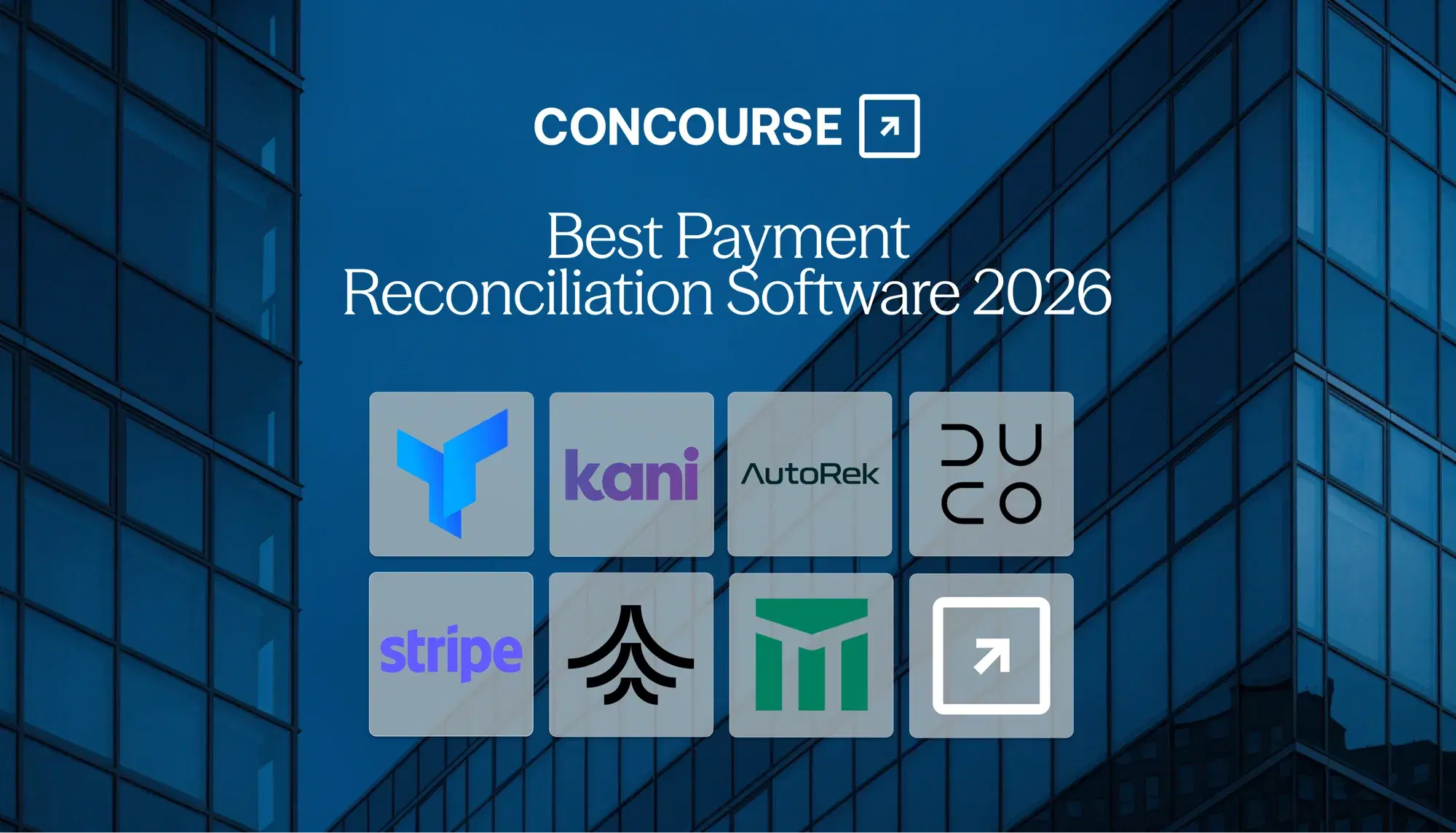
The best payment reconciliation software in 2026 is Concourse for teams that want AI agents to reconcile payments across processors, banks, and the ledger, Modern Treasury for API-first payment operations and reconciliation, Stripe for reconciling Stripe payments, Kani Payments for card programs and fintechs, Nilus for AI matching across bank, ERP, and processor data, Trovata for bank and cash reconciliation, AutoRek for regulated financial services, and Duco for high-volume, complex data.
Concourse is the AI-agent option on this list. Instead of a tool you configure and operate, Concourse deploys autonomous finance agents that connect to your payment processors, banks, and ERP and reconcile the payments themselves, matching settlements and payouts to the bank and the ledger, netting fees, refunds, and chargebacks, and flagging the exceptions that need a human, with every match traceable to source and a person approving.
How we evaluated payment reconciliation software
Payment reconciliation tools are not interchangeable; a Stripe-first SaaS company and a card-program fintech reconciling scheme files need very different things. We compared these across the criteria that change the decision:
- Source coverage. How many processors, gateways, banks, and ERPs it connects, since reconciliation is only as good as the data it can pull.
- Fees, refunds, and chargebacks. Whether it nets processor fees and accounts for refunds, chargebacks, and adjustments automatically.
- Settlement and payout timing. How it handles the gap between a transaction and the bank payout, and reconciles batched settlements.
- Automation depth. How much matching is truly automated versus assisted, and how exceptions are surfaced.
- Audit trail and controls. Whether every match ties back to source and is defensible to an auditor.
- AI capability. From rules-based matching to AI agents that perform the reconciliation.
Payment reconciliation software compared
| Software | Best for | Reconciliation strength | Ideal size |
|---|---|---|---|
| Concourse | AI agents that run payment reconciliation | Processor-bank-ledger matching, exceptions (agentic) | Startup to enterprise |
| Modern Treasury | API-first payment operations | Processor-to-bank-to-ledger | Mid-market to enterprise |
| Stripe | Reconciling Stripe payments | Stripe payouts, fees, refunds | SMB to enterprise |
| Kani Payments | Card programs & fintechs | Processor/scheme file recon + reporting | SMB to mid-market |
| Nilus | AI matching across sources | Bank, ERP, and processor matching | SMB to mid-market |
| Trovata | Bank & cash reconciliation | Multi-bank to GL | Mid-market to enterprise |
| AutoRek | Regulated financial services | Rules-based transaction matching | Enterprise |
| Duco | High-volume, complex data | No-code / AI any-format matching | Enterprise |
The 8 best payment reconciliation software tools in 2026
1. Concourse, Best for AI Agents That Run Payment Reconciliation
Concourse is an AI agent platform for corporate finance. Rather than a tool you configure and operate, it connects directly to your payment processors, banks, and ERP and performs the reconciliation itself: matching settlements and payouts to the bank and the ledger, netting processor fees, accounting for refunds and chargebacks, and flagging the exceptions that need a human, on a schedule or on demand.
What sets it apart from a reconciliation tool is the execution model. Concourse does not just surface proposed matches; its agents do the matching and the exception research, and every result traces back to source data and is validated against evals built for your business, which is what makes the output defensible to an auditor. It meets teams where they work, inside ChatGPT, Claude, Slack, Teams, and email, and connects to 100+ systems including NetSuite, QuickBooks, Snowflake, and Stripe. Concourse reports customer results including a 75% reduction in manual work and 20+ hours saved per user per month, and is SOC 2 Type II certified. See our guides to account reconciliation automation and cash application for how this fits the wider picture.
Best for. Teams that want AI agents to actually perform payment reconciliation across processors, banks, and the ledger, with full traceability, rather than a tool to manage it in.
Keep in mind. Concourse reconciles across the systems you already use; it is not itself a payment processor or bank. Many teams run Concourse for the reconciliation alongside their processors and ERP.
2. Modern Treasury, Best for API-First Payment Operations
Modern Treasury is a payment operations platform that initiates, approves, tracks, and automatically reconciles money movement across bank accounts and rails, matching expected against settled payments and writing back to the ledger through its API. It raised an $85M Series C led by Altimeter Capital in 2021 at a valuation over $2 billion.
Best for. Mid-market to enterprise teams that move money at scale and want reconciliation built into their payment operations.
Keep in mind. It is developer- and API-first, so realizing the reconciliation value usually takes engineering integration rather than a plug-and-play finance UI.
3. Stripe, Best for Reconciling Stripe Payments
Stripe reconciles Stripe payment activity, and imported external transactions, accounting for fees, refunds, chargebacks, and currency, and ties it back to revenue and the ledger. Its reconciliation capability deepened when it acquired payments-reconciliation company Recko in 2021.
Best for. SMB to enterprise teams whose payments run primarily through Stripe.
Keep in mind. It is strongest when Stripe is your main processor; it is not designed to be a neutral, multi-processor reconciliation hub.
4. Kani Payments, Best for Card Programs and Fintechs
Kani Payments is a reconciliation and reporting engine built for payments companies, card programs, and fintechs, normalizing fragmented processor and scheme files, reconciling high transaction volumes, and producing audit-ready compliance reports. It was founded in 2018 and is based in Newcastle upon Tyne, UK.
Best for. Fintechs and card-program operators reconciling processor and scheme files at volume.
Keep in mind. It is specialized for payments back offices, so it is less of a fit for a general corporate finance team reconciling one bank account to the GL.
5. Nilus, Best for AI Matching Across Sources
Nilus is a financial-operations platform whose AI classifies transactions and matches data from banks, ERPs, and payment processors to invoices and expected cash flows, speeding reconciliation across sources. It raised an $8.6M seed round led by Bessemer Venture Partners in 2022.
Best for. SMB to mid-market teams that want AI matching across bank, ERP, and processor data without a heavy build.
Keep in mind. It overlaps partly with cash application and invoice matching, so confirm its processor-payout-to-ledger depth fits your exact workflow.
6. Trovata, Best for Bank and Cash Reconciliation
Trovata automates multi-bank cash reporting, GL entry, and reconciliation through direct bank API connections, matching bank transactions to accounting records. It raised a Series A led by Wells Fargo Strategic Capital in 2021.
Best for. Mid-market to enterprise treasury teams whose reconciliation is bank- and cash-centric.
Keep in mind. It is bank- and cash-focused; processor payout, fee, and chargeback reconciliation is lighter than in dedicated payment-ops tools. See automating bank reconciliation.
7. AutoRek, Best for Regulated Financial Services
AutoRek is a rules-driven financial-controls and reconciliation platform used by regulated financial-services firms to automate bank, cash, and transaction matching with a full audit trail, including payments and cash allocation. It is a Glasgow, Scotland-based reconciliation platform with deep roots in the sector.
Best for. Banks, insurers, and regulated enterprises that need controls-grade transaction reconciliation.
Keep in mind. It targets regulated enterprises and is a heavier, configuration-led implementation, which can be more than a lean payment-ops team needs.
8. Duco, Best for High-Volume, Complex Data
Duco is a no-code, machine-learning data-automation platform that reconciles large, complex, any-format data sets, payments, fees, and transactions, for banks, insurers, and fintechs. In 2021, Nordic Capital acquired a majority stake.
Best for. Enterprises reconciling very high volumes of complex, varied data across systems.
Keep in mind. It is a broad data-reconciliation platform, so payout, fee, and chargeback logic must be configured rather than coming pre-built.
Also worth a look: enterprise AR and treasury platforms like HighRadius handle payment and bank reconciliation inside a broader order-to-cash suite, a fit if your reconciliation sits alongside heavy AR. See account reconciliation software for that end of the field.
Types of payment reconciliation software
"Payment reconciliation software" spans several distinct jobs, and the right tool depends on where your payments flow. The main types:
- Payment operations platforms initiate and reconcile money movement across banks and rails via API (Modern Treasury).
- Processor-native reconciliation reconciles the payments running through one processor (Stripe).
- Card-program and fintech reconciliation normalizes and reconciles processor and scheme files at volume (Kani Payments).
- Bank and cash reconciliation matches bank activity to the ledger (Trovata). See automating bank reconciliation.
- Financial-services transaction matching reconciles high-volume, complex data under controls (AutoRek, Duco).
- AI agents go beyond proposing matches and actually perform the reconciliation across processors, banks, and the ledger.
Which payment reconciliation software is right for you?
There is no single best payment reconciliation software, only the best fit for where your payments flow and how much you want automated.
- Choose Concourse if you want AI agents to perform payment reconciliation across processors, banks, and the ledger, with every match traceable.
- Choose Modern Treasury if you move money at scale and want reconciliation built into API-first payment operations.
- Choose Stripe if your payments run primarily through Stripe.
- Choose Kani Payments if you run a card program or fintech reconciling processor and scheme files.
- Choose Nilus if you want AI matching across bank, ERP, and processor data without a heavy build.
- Choose Trovata if your reconciliation is bank- and cash-centric.
- Choose AutoRek or Duco if you are a regulated or high-volume enterprise needing controls-grade matching.
The clearest shift in 2026 is between tools that give you a better place to manage payment reconciliation and AI agents that perform it across your systems. Most of this list is the former; the AI-agent layer is the latter.
Frequently asked questions
What is the best payment reconciliation software?
It depends on where your payments flow. Modern Treasury leads for API-first payment operations, Stripe for Stripe-centric payments, Kani Payments for card programs and fintechs, Trovata for bank and cash, and AutoRek or Duco for regulated, high-volume enterprises. For teams that want AI agents to actually perform the reconciliation with full traceability, Concourse is the strongest AI-agent option.
What is payment reconciliation?
Payment reconciliation is the process of matching payments across systems: the transaction, the processor payout, the amount that lands in the bank, and the record in the ledger, netting fees and accounting for refunds and chargebacks. It confirms that the money a business expected to receive actually arrived and is booked correctly.
What is the difference between payment reconciliation and cash application?
Cash application matches incoming customer payments to open AR invoices. Payment reconciliation is broader: it matches payments across the processor, the bank, and the ledger, including fees, refunds, and chargebacks. They overlap, and some platforms, and AI agents like Concourse, cover both.
How is an AI agent different from payment reconciliation software?
Traditional payment reconciliation software gives a team a place to configure rules and review proposed matches. An AI agent platform like Concourse performs the reconciliation itself, matching payouts to the bank and ledger, netting fees, and resolving exceptions across your systems, with a human approving. One manages the process; the other does the work.
The bottom line
Payment reconciliation software ranges from API-first payment-operations platforms to processor-native tools to enterprise transaction-matching engines, and the right one depends on where your payments flow and how much you want automated. Modern Treasury and Stripe anchor the payment-ops and processor ends, Kani and Nilus serve fintechs and lean teams, and AutoRek and Duco handle regulated, high-volume enterprises.
The bigger shift is from software that helps you manage payment reconciliation to software that performs it. If you want to see what AI agents can do across processors, banks, and the ledger, with every match traceable and audit-ready, book a demo of Concourse.