10 Best AI Workflow Automation Tools in 2026
AI workflow automation tools range from no-code connectors to enterprise platforms and AI agents that run whole processes. Here are the 10 best AI workflow automation tools in 2026, from Concourse and Zapier to UiPath and n8n, compared by who they are for.

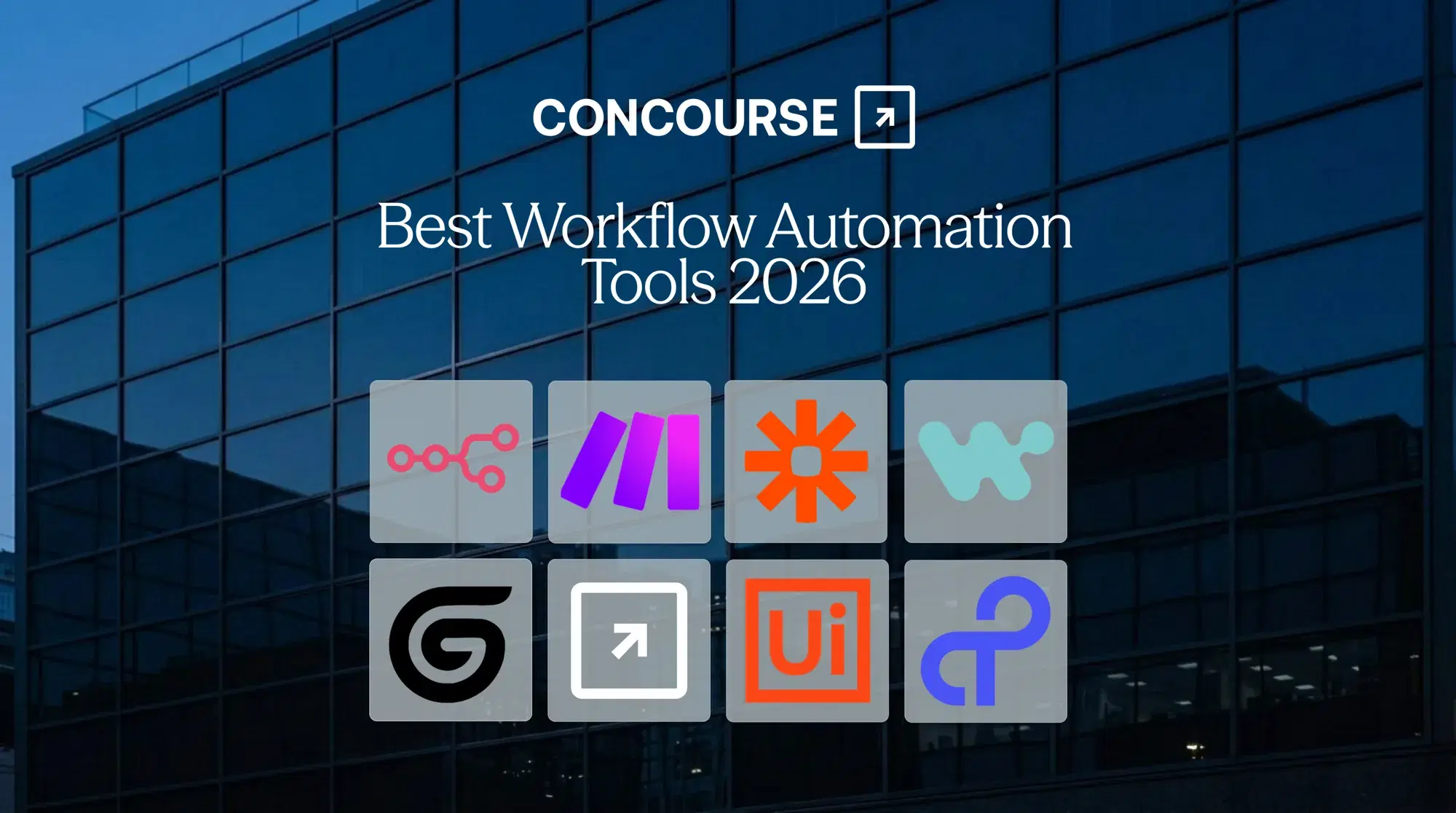
Workflow automation used to mean wiring up triggers and actions: when this happens in one app, do that in another. AI changed the ceiling. The newest tools do not just move data between apps on a fixed rule, they read unstructured inputs, make decisions, and run whole multi-step processes, with AI agents increasingly doing the work rather than just routing it. "AI workflow automation tools" now spans everything from simple no-code connectors to enterprise platforms and autonomous agents.
This guide compares the ten best AI workflow automation tools in 2026 across that range, with who each is actually for. For the finance-specific view, see our guide to automation in finance; for the shift to agent-driven automation, see agentic automation.
The types of AI workflow automation tool
- AI agents / agentic platforms that run whole workflows end to end, reading inputs, deciding, and acting: Concourse, and increasingly the others as they add agents.
- No-code connectors that automate across many SaaS apps: Zapier, Make, Gumloop.
- Developer / self-host platforms with code-level control: n8n.
- Enterprise iPaaS and RPA for governed, large-scale automation: Workato, Microsoft Power Automate, UiPath, Tray.ai, Celigo.
AI workflow automation tools compared
| Tool | Type | Best for |
|---|---|---|
| Concourse | AI agents (enterprise) | Finance workflows, run end to end |
| Zapier | No-code connectors | Wiring up many SaaS apps fast |
| Make | No-code visual | Branching visual workflows |
| n8n | Developer / self-host | Technical teams wanting control |
| Microsoft Power Automate | Enterprise + RPA | Microsoft-ecosystem automation |
| Workato | Enterprise iPaaS | Governed, mission-critical integration |
| UiPath | RPA + agentic | High-volume legacy process automation |
| Gumloop | AI-native no-code | AI-powered content & data pipelines |
| Tray.ai | Low-code iPaaS | Flexible integrations + governed agents |
| Celigo | iPaaS | ERP/ecommerce back-office integration |
The 10 best AI workflow automation tools in 2026
1. Concourse, Best for Enterprise Finance Workflows
Concourse is an AI workflow automation platform for enterprise finance, built around agents rather than fixed if-this-then-that rules. It connects to your ERP, data warehouse, billing, and source systems and runs finance workflows end to end, forecasting, variance analysis, reconciliations, and reporting, reading the data, doing the work, and producing the output, with a human approving.
What sets it apart from a general connector is that it automates the judgment-adjacent work, not just the data movement, and every output traces back to source and is validated against evals built for your business, which is what makes it safe for finance. It is SOC 2 Type II certified, connects to 100+ systems including NetSuite, QuickBooks, Snowflake, Salesforce, and Stripe, and customers report cutting manual work by roughly 75% and saving 20+ hours per user per month.
Best for. Enterprises that want AI to run finance workflows end to end, with security and traceability built in, not just connect apps.
Keep in mind. Concourse is purpose-built for finance, not a general-purpose connector for arbitrary SaaS-to-SaaS automation; for the long tail of app plumbing, pair it with a tool below.
2. Zapier, Best for Connecting Many Apps Fast
Zapier is the original mainstream no-code automation platform, connecting 8,000+ apps through event-triggered "Zaps," and it has added AI through Zapier Agents and a natural-language Copilot. Founded in 2011 and famously bootstrapped (a 2021 secondary share sale valued it around $5B), it is the fastest way to wire up many SaaS tools.
Best for. Non-technical teams that want to automate across a huge range of apps with minimal setup.
Keep in mind. It is breadth-first; deep, complex logic and heavy data processing are not its strength.
3. Make, Best for Branching Visual Workflows
Make (formerly Integromat, now owned by Celonis) offers a visual, node-based canvas with more branching logic than Zapier at lower per-operation cost, and has added a Maia AI assistant and AI agents. It is a strong middle ground between simple no-code and enterprise iPaaS.
Best for. Builders who want intricate multi-step visual workflows without enterprise overhead.
Keep in mind. The visual depth has a learning curve, and it is an automation tool with AI added rather than AI-native.
4. n8n, Best for Technical Teams That Want Control
n8n is a source-available, developer-first, self-hostable automation platform with custom-code nodes and strong support for AI agent orchestration. Founded in 2019 in Berlin, it raised a $180M Series C led by Accel at a $2.5B valuation in October 2025. It removes the "no connector exists" ceiling for teams willing to work in code.
Best for. Technical teams and self-hosters that want control, extensibility, and data residency.
Keep in mind. The flexibility comes with more setup than a pure business-user tool.
5. Microsoft Power Automate, Best for Microsoft Shops
Power Automate is Microsoft's automation layer across the Power Platform, combining cloud flows, RPA (desktop bots), and AI, now deeply infused with Copilot for natural-language flow building and agent flows. For Microsoft-ecosystem organizations, it is automation native to the stack and licensing. Microsoft is public (NASDAQ: MSFT).
Best for. Microsoft 365, Dynamics, and Azure shops that want automation and RPA built in.
Keep in mind. Its value is tied to the Microsoft ecosystem.
6. Workato, Best for Governed Enterprise Integration
Workato is an enterprise iPaaS built for governed, mission-critical automation at scale, with strong security, approvals, and AI-assisted "recipes." Founded in 2013, it raised a $200M Series E led by Battery Ventures at a $5.7B valuation in 2021 (a 2021 mark). It is built for teams with dedicated integration resources.
Best for. Large enterprises that need governed, business-critical integration across many systems.
Keep in mind. It carries enterprise cost and implementation weight.
7. UiPath, Best for High-Volume Legacy Automation
UiPath is the leading dedicated RPA vendor, software robots that automate repetitive, UI-driven tasks, now pivoting to agentic automation that combines bots with AI agents. Founded in 2005 and publicly traded on the NYSE under ticker PATH since its 2021 IPO, it is the enterprise standard for automating legacy, screen-based processes.
Best for. Enterprises automating high-volume, rules-based legacy and desktop processes.
Keep in mind. Classic RPA is brittle when screens change; evaluate its newer agentic capabilities for anything that varies.
8. Gumloop, Best for AI-Native No-Code Pipelines
Gumloop is an AI-native no-code platform where language models are first-class workflow nodes, so you can build "intelligent pipelines" that read, analyze, and generate content and data. A Y Combinator (W24) company founded in 2023, it raised a $50M Series B led by Benchmark in 2026. It targets business teams building AI-powered automations without code.
Best for. Ops and business teams building AI-driven content and data workflows on a canvas.
Keep in mind. As with any no-code canvas, design, testing, and maintenance are on you.
9. Tray.ai, Best for Flexible Low-Code Integration
Tray.ai (formerly Tray.io) is a low-code enterprise iPaaS that rebranded to emphasize its AI agent pivot, adding its Merlin Agent Builder for governed, no-code AI agents in production. Founded in 2012 and based in San Francisco, it is popular with mid-market-to-enterprise RevOps and GTM teams.
Best for. Teams wanting flexible low-code integrations plus governed AI agents.
Keep in mind. It sits between no-code and enterprise iPaaS, so scope it to your complexity.
10. Celigo, Best for ERP and Back-Office Integration
Celigo's integrator.io platform is an iPaaS strong in prebuilt business-app integrations, especially NetSuite, ERP, and ecommerce back-office. Founded in 2011 and based in California, it raised a $48.5M Series C in 2021. It is a common pick for ops teams integrating finance and ecommerce systems.
Best for. Ops and IT teams integrating ERP, ecommerce, and finance systems, especially NetSuite-heavy orgs.
Keep in mind. Its strength is prebuilt integration rather than AI-native, agent-led automation.
Also worth knowing: Lindy and Relay.app are newer AI-native no-code builders, and Pipedream is a developer-first integration platform, though it is being acquired by Workday, so treat it as part of Workday's stack going forward rather than an independent tool.
No-code connector vs. AI agent
The most important distinction in this category is between tools that route work and tools that do it. A no-code connector like Zapier or Make fires an action when a trigger happens, you still design every step, and a human does the judgment. An AI agent platform takes a goal and runs the whole process, reading messy inputs, making the calls, and producing the output, with a human approving.
For simple app-to-app plumbing, a connector is perfect. For work that involves judgment, unstructured data, and real stakes, like a finance close or a reconciliation, you want an agent that does the work and ties every output back to source, not a rule that just moves data between systems.
That is the line between most tools on this list and an enterprise agent platform like Concourse. Many teams use both: a connector for the long tail of integrations, and agents for the high-value, judgment-heavy workflows. See our guide to agentic automation for the fuller picture.
How to choose an AI workflow automation tool
- For high-value, judgment-heavy workflows (especially finance), an AI agent platform like Concourse that runs the work end to end with traceability.
- For connecting many SaaS apps fast, Zapier or Make.
- For technical control and self-hosting, n8n.
- For governed enterprise integration, Workato, Power Automate, Tray.ai, or Celigo.
- For high-volume legacy process automation, UiPath.
- Whatever you choose, weight security, governed data access, and traceability for anything touching core systems.
Frequently asked questions
What are the best AI workflow automation tools?
It depends on the work. For connecting many apps, Zapier and Make; for technical control, n8n; for governed enterprise integration, Workato, Power Automate, Tray.ai, and Celigo; for legacy RPA, UiPath; and for AI agents that run high-value workflows end to end, especially in finance, Concourse. There is no single best tool, only the best fit for the workflow.
What is the difference between workflow automation and AI workflow automation?
Traditional workflow automation follows fixed rules, when a trigger fires, do a set action, and a person handles anything that needs judgment. AI workflow automation adds models and agents that can read unstructured inputs, make decisions, and run multi-step work, so the tool does more of the process itself rather than just routing data.
What is the best AI workflow automation tool for finance?
For finance, a general connector handles app-to-app plumbing, but the high-value work, close, reconciliations, forecasting, reporting, needs an agent that can do the work and tie every number back to source. Concourse is purpose-built for that: AI agents that run finance workflows end to end with audit-ready traceability.
The bottom line
The best AI workflow automation tool depends on the job: connectors like Zapier and Make for app plumbing, n8n for technical control, enterprise iPaaS and RPA like Workato, Power Automate, and UiPath for governed scale, and AI agent platforms like Concourse for high-value workflows that need judgment and traceability. The clear 2026 shift is from tools that route work to agents that do it.
If the workflows you most want automated are in finance, close, reconciliation, forecasting, and reporting, see what agents that run them end to end can do, with every number traceable to source, and talk to our team.