8 Best Accounting Automation Software Tools in 2026
Accounting automation software takes over the repetitive work of accounting: AP, AR, reconciliations, journal entries, and the close. Here are the 8 best accounting automation software tools in 2026, from BlackLine and Bill to AI agents like Concourse, compared by what they automate, fit, and cost.

Accounting runs on repetitive work: coding invoices, chasing receivables, matching transactions, booking entries, and closing the books every period. Accounting automation software takes that work off the team, and the category is broad, because accounting is broad. One tool automates payables, another receivables, another the close, and a new wave of AI agents runs the work across all of them.
This guide compares the eight best accounting automation software tools in 2026 by what they actually automate, who they fit, and where they fall short, so you can match a tool to your biggest bottleneck instead of buying the loudest brand. For the workflows behind the categories, see our guides to financial close automation, account reconciliation software, and automated financial reporting.
What is the best accounting automation software?
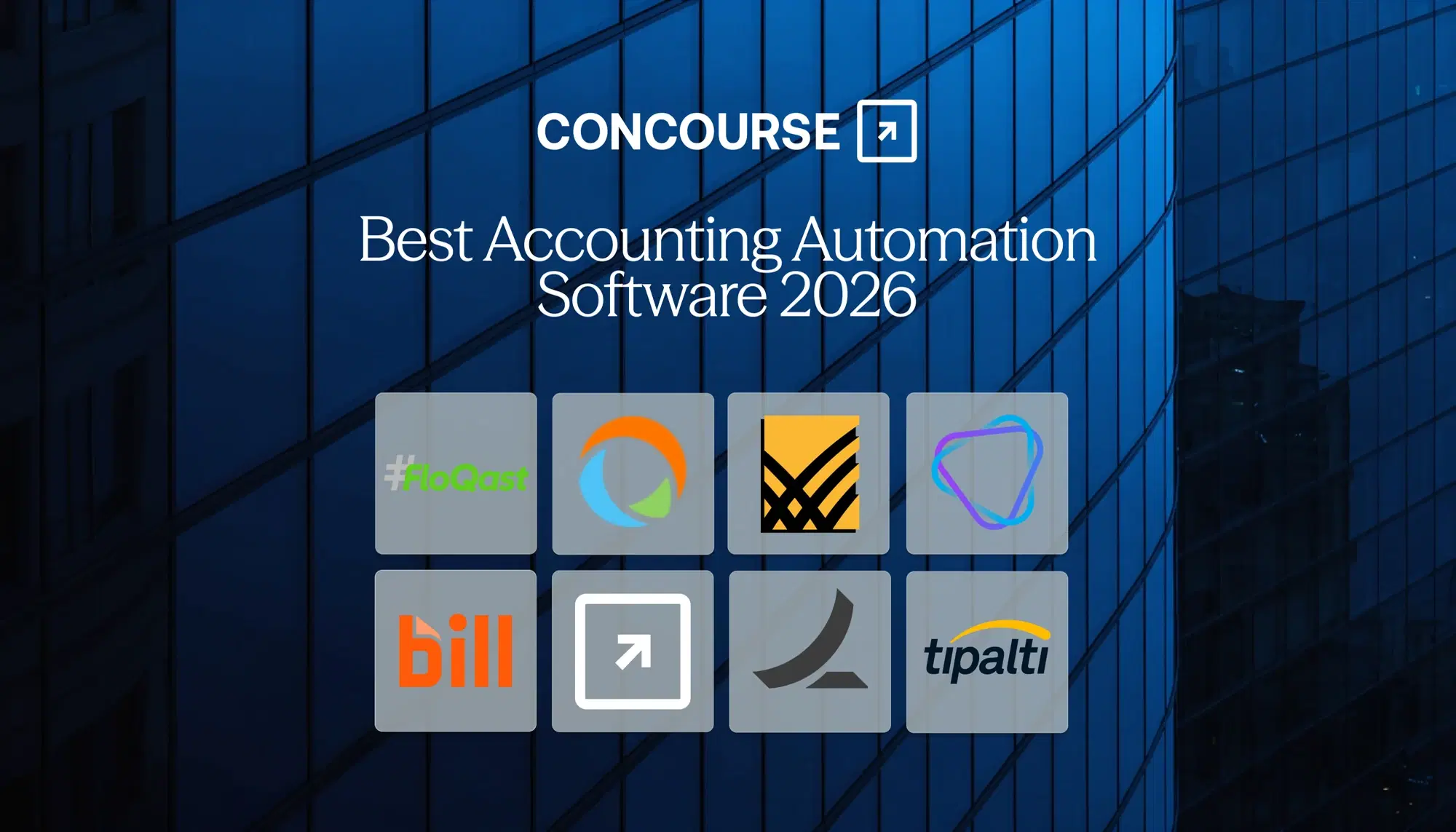
The best accounting automation software depends on which work you want to automate. Concourse is the pick for teams that want AI agents to run accounting workflows, reconciliations, entries, collections, and reporting, across their existing systems with every number traceable to source. For close and reconciliation it is BlackLine; for SMB and mid-market AP and AR, Bill; for global payables, Tipalti; for enterprise receivables, HighRadius; for AI-first invoice processing, Vic.ai; for spend and card-driven automation, Ramp; and for accounting-team close management, FloQast.
Concourse is the AI-agent option on this list. Rather than a single-workflow point tool, Concourse deploys finance agents that connect to your ERP, data warehouse, billing, and banking data and run accounting work across them: reconciling accounts, drafting journal entries, chasing receivables, and assembling reporting, with every output traceable back to source and a human approving.
Why teams automate accounting
Manual accounting is slow, error-prone, and impossible to scale without adding headcount. Automation attacks the work in a few distinct places, and most teams need more than one:
- Accounts payable. Capturing invoices, routing approvals, and paying suppliers without manual data entry.
- Accounts receivable. Invoicing, cash application, and collections follow-ups to get paid faster. See AR automation with AI agents.
- Reconciliations. Matching ledgers to banks and subledgers and surfacing only the exceptions. See bank reconciliation automation.
- Journal entries and the close. Drafting entries and running the period-end close. See journal entry automation.
The honest framing: most of these tools own one lane. A payables platform is not a close tool, and a spend platform is not a reconciliation engine. The clearest 2026 shift is an AI-agent layer that runs the recurring work across all of them, on top of the specialists you keep.
How we evaluated accounting automation software
We compared the tools across the criteria that decide fit for a finance or accounting team, not just feature checklists.
- What it automates. AP, AR, reconciliation, journal entries, the close, or several.
- Automation depth. Whether it executes the work or mainly structures and tracks it.
- AI capability. From rules-based automation to autonomous agents.
- Integration. How cleanly it connects to your ERP, banks, and billing systems.
- Auditability. Whether every figure traces back to source and holds up to an auditor.
- Fit. Ideal company size, from SMB to global enterprise.
Accounting automation software compared
| Software | What it automates | Best for |
|---|---|---|
| Concourse | Reconciliation, entries, AR, reporting (agentic) | Teams that want agents to run the work |
| BlackLine | Close and reconciliation | Enterprise controllership |
| Bill | AP and AR payments | SMB and mid-market |
| Tipalti | Global accounts payable | Scaling companies with global suppliers |
| HighRadius | Receivables and order-to-cash | Large enterprise AR |
| Vic.ai | AI invoice and AP processing | Touchless AP, accounting firms |
| Ramp | Spend, cards, and close acceleration | Startups to mid-market |
| FloQast | Close management | Accounting teams |
The 8 best accounting automation software tools in 2026
1. Concourse, Best for AI Agents That Run Accounting Work
Concourse is an AI agent platform for corporate finance. Instead of automating one lane, it connects to your ERP, data warehouse, billing, and banking data and runs accounting work across them: reconciling accounts and flagging exceptions, drafting journal entries, chasing receivables through an AR and collections agent, and assembling reporting on a schedule.
The difference is the execution model and the breadth. Concourse does not ask you to move a workflow into a new system of record; its agents work across the tools you already run, and every output traces back to source data and is validated against evals built for your business. It meets teams inside ChatGPT, Claude, Slack, Teams, and email, exports to Excel and PowerPoint, reports customer results including a 75% reduction in manual work and 20+ hours saved per user per month, is SOC 2 Type II certified, and connects to 100+ systems including NetSuite, QuickBooks, Snowflake, Salesforce, and Stripe.
Best for. Finance and accounting teams that want AI agents to run the recurring work, reconciliation, entries, collections, and reporting, across their existing stack with full traceability.
Keep in mind. Concourse is an agent layer, not a dedicated AP payments rail or a corporate card. For high-volume supplier payments or card issuing, run it alongside a specialist.
2. BlackLine, Best for Close and Reconciliation
BlackLine is the enterprise standard for automating the close, with deep account reconciliation, transaction matching, and journal-entry automation on a governed cloud platform. It is a public company (Nasdaq: BL), and per its FY2024 Form 10-K it served 4,443 customers and 397,477 individual users as of December 31, 2024.
Best for. Mid-market to large enterprise controllership teams running a complex, high-volume monthly close.
Keep in mind. It is priced and scoped for larger organizations and is heavier to implement than lightweight tools, so it can be overkill for small teams.
3. Bill, Best for SMB and Mid-Market AP and AR
Bill (formerly Bill.com) automates accounts payable and receivable for smaller businesses and the accounting firms that serve them: invoice capture, approval routing, bill payment, and reconciliation. It is a public company (NYSE: BILL) and states it is trusted by nearly half a million businesses and 9,000 accounting firms.
Best for. Small businesses, mid-market finance teams, and accounting firms that want simple AP and AR automation.
Keep in mind. Its strength is AP and AR payments, not the close; deeper reconciliation and close work still needs a close tool or ERP, and users commonly cite transaction fees.
4. Tipalti, Best for Global Accounts Payable
Tipalti automates end-to-end global accounts payable and mass supplier payments, including onboarding, tax and compliance, and cross-border payouts. Founded in 2010, it secured $200 million in growth financing in September 2025 and has surpassed $200 million in ARR.
Best for. Fast-scaling mid-market companies with international suppliers and high payment volumes across many countries.
Keep in mind. It is AP-centric, so it is not a receivables, reconciliation, or close tool, and it is priced for mid-market and up.
5. HighRadius, Best for Enterprise Receivables
HighRadius automates accounts receivable and order-to-cash at enterprise scale: credit, cash application, collections, deductions, and e-invoicing, with autonomous features throughout. It raised a $300M Series C at a $3.1B valuation in 2021 and was named a Leader in the 2024 Gartner Magic Quadrant for invoice-to-cash.
Best for. Large enterprises with big receivables operations that want AI-driven order-to-cash automation.
Keep in mind. It is built for enterprise AR and is likely too heavy and expensive for SMB and mid-market accounting needs.
6. Vic.ai, Best for AI Invoice and AP Processing
Vic.ai is an AI-first AP automation tool focused on touchless invoice processing: autonomous data capture, GL coding, and approval routing with high accuracy. It raised a $52M Series C in December 2022 led by GGV Capital and ICONIQ Growth, bringing total funding to $115M.
Best for. Accounting firms and finance teams that want an AI-led AP layer with high-accuracy invoice capture.
Keep in mind. It is younger and narrower than the incumbents, AP-centric, so it is not a full-suite accounting platform.
7. Ramp, Best for Spend and Close Acceleration
Ramp pairs corporate cards and spend management with accounting automation: expense coding, approvals, bill pay, and reconciliation that syncs to the ERP and speeds the close. Founded in 2019, it reached a $32B valuation in November 2025, reporting 50,000+ customers and over $1B in annualized revenue.
Best for. Startups through mid-market finance teams consolidating cards, expenses, AP, and spend controls in one platform.
Keep in mind. Its accounting automation is tied to spend and card data, not a dedicated close suite, so teams needing deep reconciliation or consolidation still pair it with a close tool.
8. FloQast, Best for Accounting-Team Close Management
FloQast was built by accountants and sits on top of the ERP and Excel to manage the month-end close: reconciliations, checklists, flux analysis, and compliance workflows. Founded in 2013, it raised a $100M Series E in April 2024 at a $1.6B valuation led by ICONIQ Growth, serving 2,600+ accounting teams.
Best for. Mid-market and lighter-enterprise accounting teams that want to manage and speed up the close without replacing the ERP.
Keep in mind. It is focused on close management and workflow, not AP or AR payments, so it orchestrates the close rather than executing transactional accounting.
Also worth a look: Vena and Prophix (close and planning), Numeric (AI-native close), Esker (source-to-pay and order-to-cash), and the native automation inside ERPs like NetSuite, QuickBooks, Sage Intacct, and Xero.
Which accounting automation software is right for you?
Start from the work you most need to take off the team:
- Choose Concourse if you want AI agents to run accounting work, reconciliation, entries, collections, and reporting, across the systems you already have, with every number traceable.
- Choose BlackLine if the priority is enterprise close and reconciliation.
- Choose Bill if you are an SMB or mid-market team that wants simple AP and AR automation.
- Choose Tipalti if global accounts payable is your bottleneck.
- Choose HighRadius if you are an enterprise with high-volume receivables.
- Choose Vic.ai if you want AI-first, touchless invoice processing.
- Choose Ramp if you want spend, cards, and expense automation that accelerates the close.
- Choose FloQast if you want accounting-team close management without replacing the ERP.
The pattern across 2026 is that the strongest accounting stacks pair a specialist for a high-volume lane with an agent layer that runs the recurring work on top, rather than trying to buy one tool that does everything.
Frequently asked questions
What is accounting automation software?
Accounting automation software is any tool that takes over repetitive accounting work, coding and paying invoices, invoicing and collecting from customers, matching transactions, booking journal entries, and closing the books, so the team can focus on review and analysis. Different tools automate different lanes, so most teams use more than one.
What is the best accounting automation software?
It depends on the work you want to automate. BlackLine leads close and reconciliation, Bill leads SMB and mid-market AP and AR, Tipalti leads global payables, and HighRadius leads enterprise receivables. For teams that want AI agents to run accounting workflows across their existing systems with full traceability, Concourse is the strongest AI-agent option.
How is AI used in accounting automation?
AI automates the judgment-plus-rules work that older automation could not: reading and coding invoices, matching transactions and flagging reconciliation exceptions, drafting journal entries, and generating reports. AI agents like Concourse go further and run these workflows end to end across your ERP and data sources, with a human approving and every number traceable to source.
Can accounting automation software replace an accountant?
No. It automates the repetitive tasks, not the role. Reconciliations, data entry, and report assembly get automated, while accountants shift toward review, judgment, controls, and analysis. The durable model is agents doing the work with a human approving, which is how Concourse is designed.
The bottom line
There is no single best accounting automation software, because accounting is not a single task. Match the tool to the work: payables, receivables, reconciliation, or the close. The clearest shift in 2026 is the AI-agent layer that runs the recurring work across all of them, on top of whatever specialists you keep.
If you want to see what AI agents can do across reconciliation, journal entries, collections, and reporting, all with every number traceable and board-ready, book a demo of Concourse and put an agent on your accounting workflows.