10 Best Agentic AI Tools in 2026
Agentic AI tools range from model platforms and developer frameworks to ready-made agents for specific jobs. Here are the 10 best agentic AI tools in 2026, from OpenAI and Anthropic to vertical agents like Concourse, compared by what they are best for.

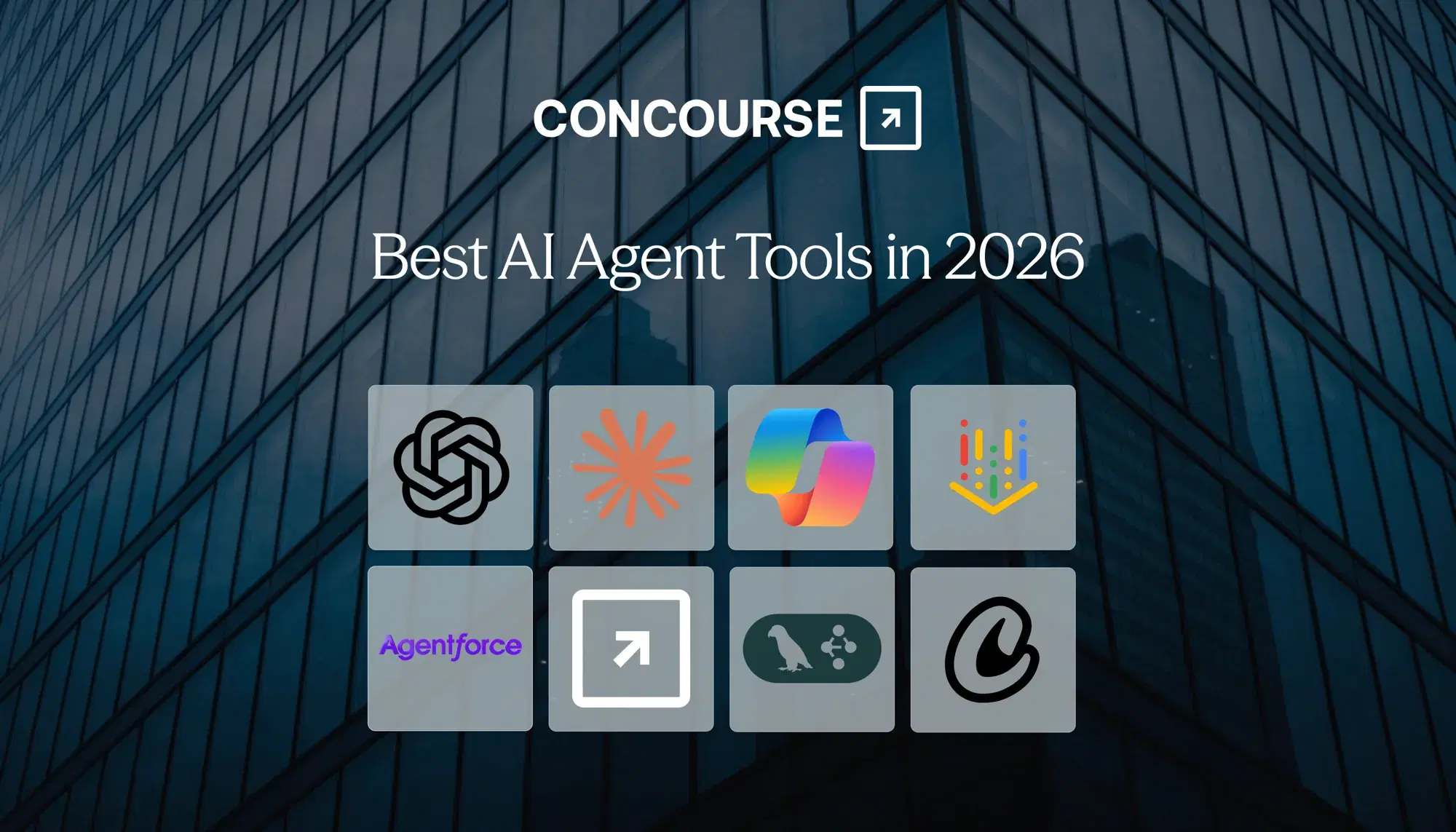
"Agentic AI tools" is a broad label, and that is the first thing to get straight, because the category mixes three very different kinds of product. There are the model platforms you build agents on (OpenAI, Anthropic, Google), the developer frameworks that orchestrate agents (LangGraph, CrewAI, and the big vendors' agent kits), and the ready-made agents built for a specific job (customer service, coding, finance). The right tool depends entirely on which of those you need.
This guide compares the ten best agentic AI tools in 2026 across all three groups, with what each is genuinely best for. For the underlying concept, see our guide to agentic AI. One honest caveat up front: most "best agentic AI tools" lists you will find are published by vendors ranking themselves, so we have organized this by category and use case rather than crowning a single winner.
The three types of agentic AI tools
- Model platforms. The frontier labs whose models do the reasoning, plus their own agent-building stacks: OpenAI, Anthropic, Google.
- Frameworks and builders. Tools to orchestrate agents, from open-source (LangGraph, CrewAI) to enterprise builders (Microsoft Copilot Studio, Salesforce Agentforce).
- Ready-made / vertical agents. Agents built to do a specific job out of the box: Sierra for customer service, Devin for coding, Concourse for finance.
Agentic AI tools compared
| Tool | Type | Best for |
|---|---|---|
| OpenAI | Model platform | Broadest ecosystem to build agents on |
| Anthropic | Model platform | Agentic coding and computer use |
| Microsoft Copilot Studio | Enterprise builder | Agents inside Microsoft 365 / Dynamics |
| Google Vertex AI | Model platform | Agents on Google Cloud / Gemini |
| Salesforce Agentforce | Enterprise builder | Agents inside the Salesforce stack |
| LangGraph | Framework | Open-source agent orchestration |
| CrewAI | Framework | Multi-agent "crews" in Python |
| Sierra | Vertical agent | Customer service agents |
| Devin (Cognition) | Vertical agent | Autonomous software engineering |
| Concourse | Vertical agent | Finance workflows, end to end |
The 10 best agentic AI tools in 2026
1. OpenAI, Best for the Broadest Ecosystem
OpenAI offers the widest agentic stack: consumer agents (ChatGPT agent mode), plus a developer platform with the Responses API, the open-source Agents SDK, and AgentKit for building and shipping agents. It is the default starting point for most teams. OpenAI is private and, per reporting, was valued around $500 billion in a 2025 secondary share sale, making it the most valuable private company in the world.
Best for. Teams that want the broadest, most-supported platform to build agents on.
2. Anthropic, Best for Agentic Coding and Computer Use
Anthropic's Claude models are leaders for agentic coding and "computer use" (controlling a screen via API), and its Claude Agent SDK exposes the same agent infrastructure behind Claude Code. Anthropic is private and raised a $13B Series F at a $183B post-money valuation in September 2025.
Best for. Developers building agents that write code or operate software.
3. Microsoft Copilot Studio, Best for the Microsoft Stack
Copilot Studio lets enterprises build autonomous agents wired into Microsoft 365 and Dynamics 365 business processes, and on the developer side the open-source Microsoft Agent Framework (which consolidates the older AutoGen project with Semantic Kernel) handles multi-agent orchestration. Microsoft is public (NASDAQ: MSFT).
Best for. Organizations standardized on Microsoft that want agents inside their existing tools.
4. Google Vertex AI, Best for Google Cloud
Google pairs its Gemini models with an enterprise agent stack, Vertex AI's agent builder and the open-source Agent Development Kit (ADK), for building and deploying agents on Google Cloud. (Google has been consolidating this under its evolving "Gemini Enterprise" branding, so check the current product name.) Alphabet is public (NASDAQ: GOOGL).
Best for. Teams building agents on Google Cloud and Gemini.
5. Salesforce Agentforce, Best for the Salesforce Stack
Agentforce is Salesforce's "digital labor" platform, autonomous agents for service, sales, and marketing that take actions inside the Salesforce and Data Cloud stack, not just chat. Announced in September 2024 and expanded since, it is a leading enterprise agent platform. Salesforce is public (NYSE: CRM).
Best for. Salesforce customers that want agents embedded in their CRM.
6. LangGraph, Best for Open-Source Orchestration
LangGraph (from the LangChain team) is among the most-used open-source frameworks for building stateful, long-running agents, with LangSmith for observability. LangChain is private and, per secondary reporting, raised a Series B at roughly a $1.25 billion valuation in 2025.
Best for. Developers who want full control over agent orchestration in code.
7. CrewAI, Best for Multi-Agent "Crews"
CrewAI is a popular open-source Python framework for orchestrating role-based "crews" of agents that collaborate on a task, plus an enterprise platform. It raised an $18M round led by Insight Partners, with angels including Andrew Ng.
Best for. Developers building multi-agent systems where agents take distinct roles.
8. Sierra, Best for Customer Service Agents
Sierra, founded by former Salesforce co-CEO Bret Taylor and ex-Google executive Clay Bavor, builds autonomous customer-service agents (chat and voice) sold on an outcome basis. It raised $350M at a $10B valuation in September 2025.
Best for. Companies that want a ready-made agent for customer service.
9. Devin (Cognition), Best for Software Engineering
Devin, from Cognition, is an autonomous AI software engineer that takes a task and writes, tests, and ships code; Cognition also owns the Windsurf agentic IDE after acquiring it in 2025. Cognition is private and, per reporting, was valued around $10.2 billion in September 2025.
Best for. Engineering teams that want an autonomous coding agent.
10. Concourse, Best for Finance
Concourse is the vertical agentic AI tool for corporate finance. Rather than a framework you build on or a general assistant, it deploys AI agents that connect to your ERP, data warehouse, and banking data and run finance workflows, forecasting, variance analysis, reconciliations, and reporting, end to end, with every output traceable to source and a human approving. It is SOC 2 Type II certified, connects to 100+ systems, and customers report cutting manual work by roughly 75%.
Best for. Finance teams that want agentic AI purpose-built for their workflows, with audit-ready traceability.
Also worth knowing: no-code builders like Relevance AI and Lindy let non-developers assemble agents, and horizontal enterprise players (Glean, ServiceNow, and others) are adding agent capabilities to their platforms. The category is moving fast, so verify current capabilities before you buy.
How to choose an agentic AI tool
- If you are building from scratch, start with a model platform (OpenAI, Anthropic, Google) and a framework (LangGraph, CrewAI).
- If you want agents in tools you already run, use the enterprise builder for your stack (Copilot Studio, Agentforce).
- If you want a job done out of the box, choose a vertical agent: Sierra for service, Devin for code, Concourse for finance.
- Whatever you choose, prioritize security, governed data access, human-in-the-loop control, and traceability, the criteria that separate a demo from production. See our guide to enterprise AI agents.
Frequently asked questions
What are the best agentic AI tools?
It depends on what you need. For building agents, model platforms like OpenAI, Anthropic, and Google and frameworks like LangGraph and CrewAI lead. For agents inside existing software, Microsoft Copilot Studio and Salesforce Agentforce. For ready-made agents, Sierra (service), Devin (coding), and Concourse (finance). There is no single best tool, only the best fit for your use case.
What is the difference between an agentic AI platform and a framework?
A platform (like OpenAI or Google) provides the models and infrastructure agents run on. A framework (like LangGraph or CrewAI) is the software you use to orchestrate agents, defining their roles, tools, and how they coordinate. You typically use a framework on top of a model platform.
What is the best agentic AI tool for finance?
For corporate finance, Concourse is purpose-built: AI agents that run finance workflows end to end, connected to your ERP and data, with every number traceable to source and a human approving. General platforms can be used to build finance agents, but a vertical tool handles the domain, and the trust requirements, out of the box.
The bottom line
The best agentic AI tool depends on which layer you need, a model platform to build on, a framework to orchestrate, or a ready-made agent to do a job. The frontier labs lead at the model layer, LangGraph and CrewAI at orchestration, and vertical agents like Sierra, Devin, and Concourse where a specific job needs doing well.
If finance is that job, see what an agentic AI tool built for it can do, forecasting, reconciliation, and reporting run end to end with every number traceable, and talk to our team.